
Loudon's Bonnie Woods and Braes
1 score
-
Loudon's Bonnie Woods and BraesBagpipe
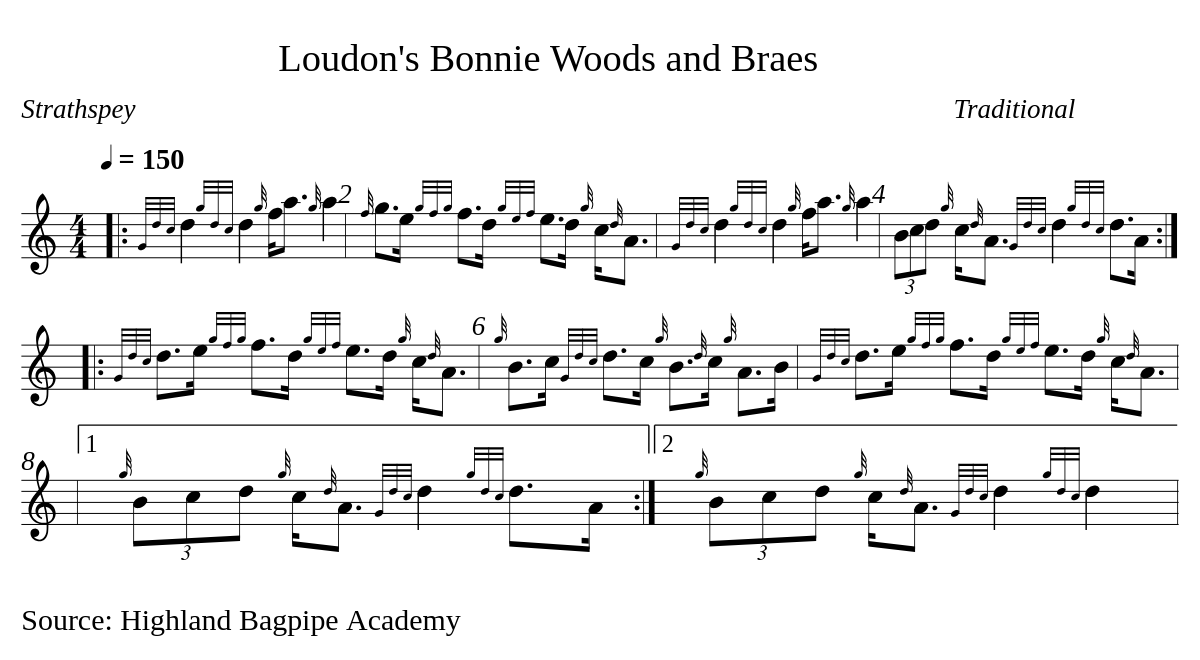
Loudon's Bonnie Woods and Braes has its origins in a Scottish song from the early nineteenth century. The words were written by the poet Robert Tannahill and set to music by R. A. Smith, around 1805 or shortly thereafter, at a time when the Earl of Moira — the future Marquess of Hastings — commanded the forces in Scotland and preparations for a military campaign abroad were in full swing. The text evokes a soldier's farewell to his young wife, with Loudon Castle in Ayrshire, surrounded by its lush woods, as the setting. The piece enjoyed enormous popularity throughout the Napoleonic Wars.
The melody is ancient: one version appears in the Betham manuscript of 1815 under the title Earl Moira's Welcome to Scotland, and it subsequently features in several major bagpipe collections — in J. & R. Glen in 1870, and in David Glen's collections of the 1880s, where it is described as an "old Gaelic air."
A strathspey in 4/4 with its characteristic dotted rhythm, it is today a cornerstone of Highland dance competitions, where it accompanies dancers through their most precise figures. Of intermediate to advanced difficulty, it is regularly played both as a solo and in pipe band, and appears in numerous standard reference collections of the Scottish repertoire.
Performances of Loudon's Bonnie Woods and Braes
Lyrics
Loudon's bonnie woods and braes,
I maun leave them a', lassie;
Wha can thole when Britain's faes
Would gi'e to Britons law, lassie?
Wha would shun the field o' danger?
Wha to fame would live a stranger?
Now when Freedom bids avenge her,
Wha would shun her ca', lassie?
Loudon's bonnie woods and braes,
Ha'e seen our happy bridal days,
And gentle hope shall soothe thy waes,
When I am far awa', lassie.
Hark! the swelling bugle rings,
Yielding joy to thee, laddie;
But the dolefu' bugle brings
Wacfu' thochts to me, laddie…