Orange and Blue
1 score
-
Orange and BlueBagpipe
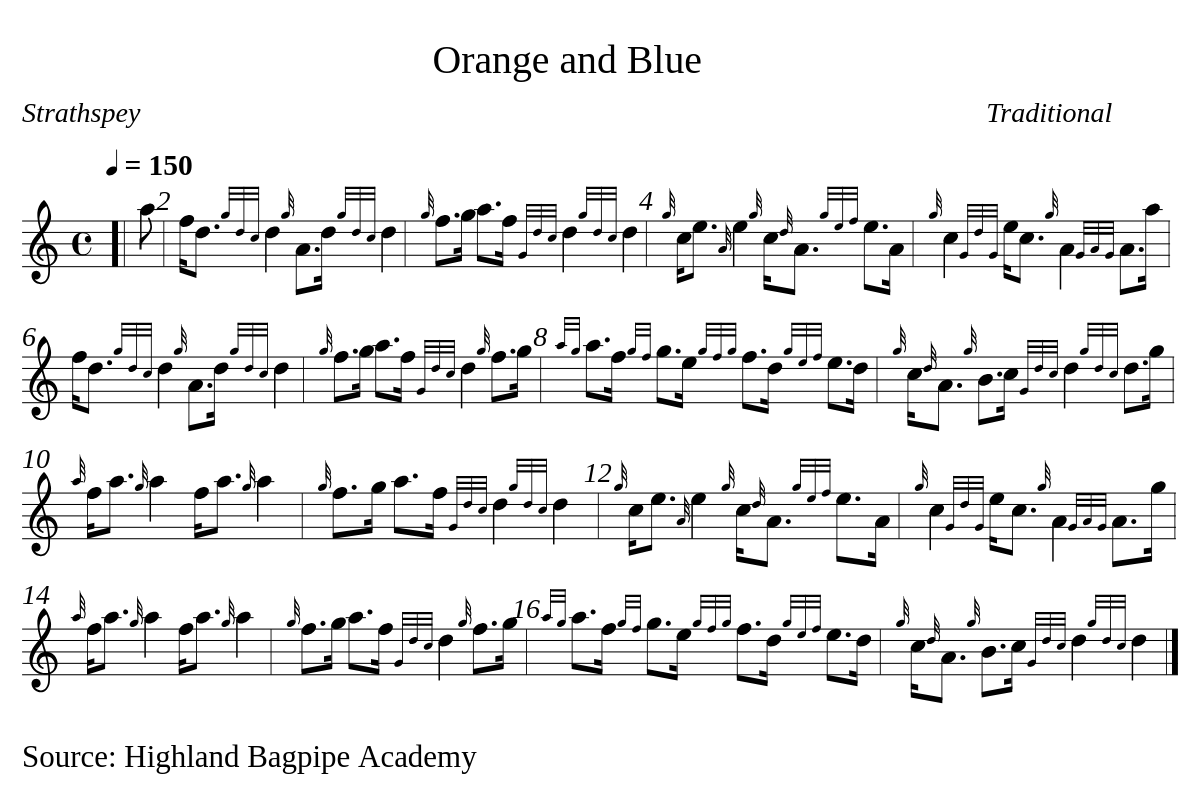
Orange and Blue is one of the oldest and most widespread strathspeys in the Scottish traditional repertoire. Its Gaelic title, Brochan Lom, means "thin porridge" — a delightful contrast with the solemnity sometimes associated with the bagpipe. The melody is known throughout the country, from the Highlands to Shetland, and circulates under numerous alternative titles: Blue Ribbon, Kitty Jones, Orange and Blue Highland Fling.
The earliest known written source dates to around 1826, in the collection Alexander's Fifty New Scotch and Irish Reels and Hornpipes, under the title The Blue Ribbon. It subsequently appears in Gow in 1817, then in many collections throughout the nineteenth century. It was played for the East Lothian country dance known precisely as "Orange and Blue". As for the origin of the title itself, several theories have been put forward: the Orange and Scottish colours, the colours of British political parties, or a Masonic lodge — none of which has gained definitive acceptance.
Today it stands as an emblematic example of the dotted-cut rhythm of the strathspey, regularly paired with Captain Horne in competition sets, and played by solo pipers and pipe bands alike.