
The Boys of Bluehill
1 score
-
The Boys of BluehillBagpipe
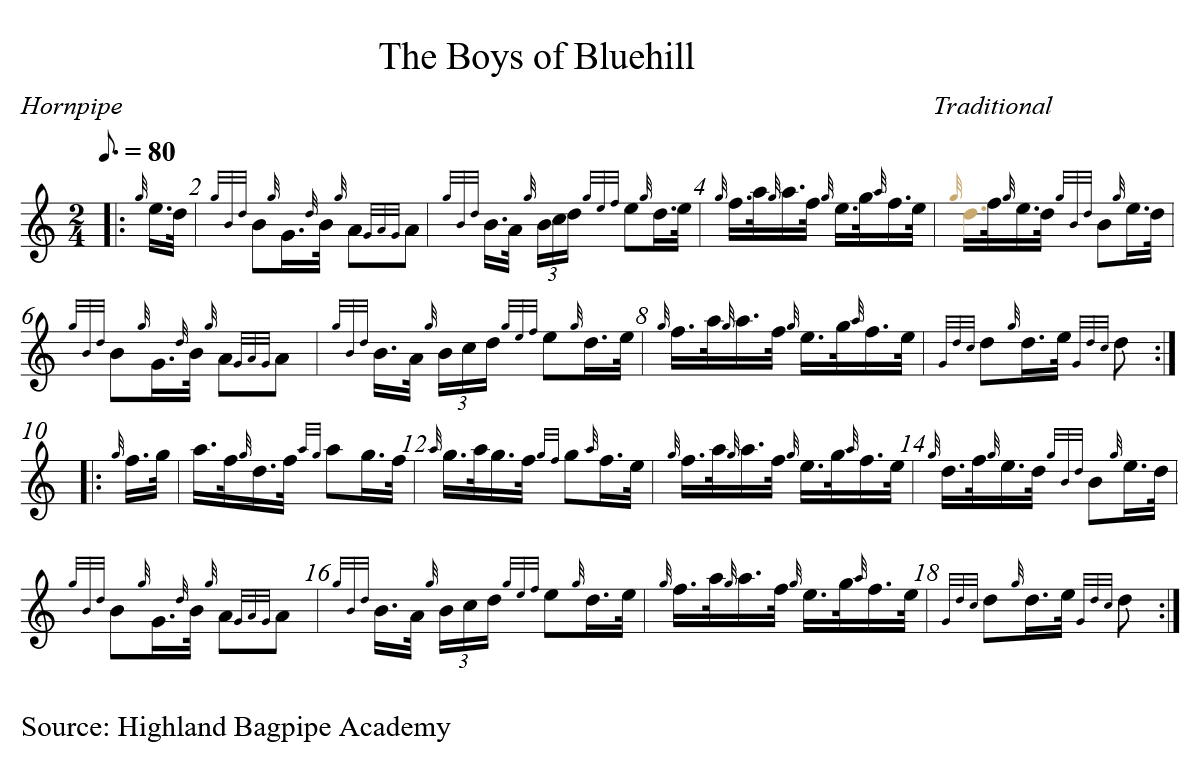
The Boys of Bluehill is one of the most widely played Irish hornpipes in the world — and probably the most played in sessions. Its popularity has sometimes led it to be associated with beginners, giving it an undeserved reputation: it is in fact an excellent foundation for variation, and its melody remains particularly catchy in its original form.
Its precise history is rather unclear. Chief O'Neill — the great collector of Irish music in Chicago at the turn of the twentieth century — recounts having come across the tune through a seventeen-year-old fiddler named George West, a gifted but penniless musician who would play out the last dances of the evening when his partner O'Malley, missing a finger, succumbed to drink. The melody is documented on record as early as 1905, and has travelled back and forth between Ireland and the United States to the point where its exact trajectory is difficult to trace.
The tune is also known in Scotland as The Beaux of Oak Hill, and in the north-east of England as The Lads of North Tyne. A hornpipe in 4/4 with its characteristic dotted rhythm, it is equally at home in Irish sessions and on the Great Highland Bagpipe, where it pairs readily with other hornpipes.