Auld Lang Syne
1 score
-
Auld Lang SyneBagpipe
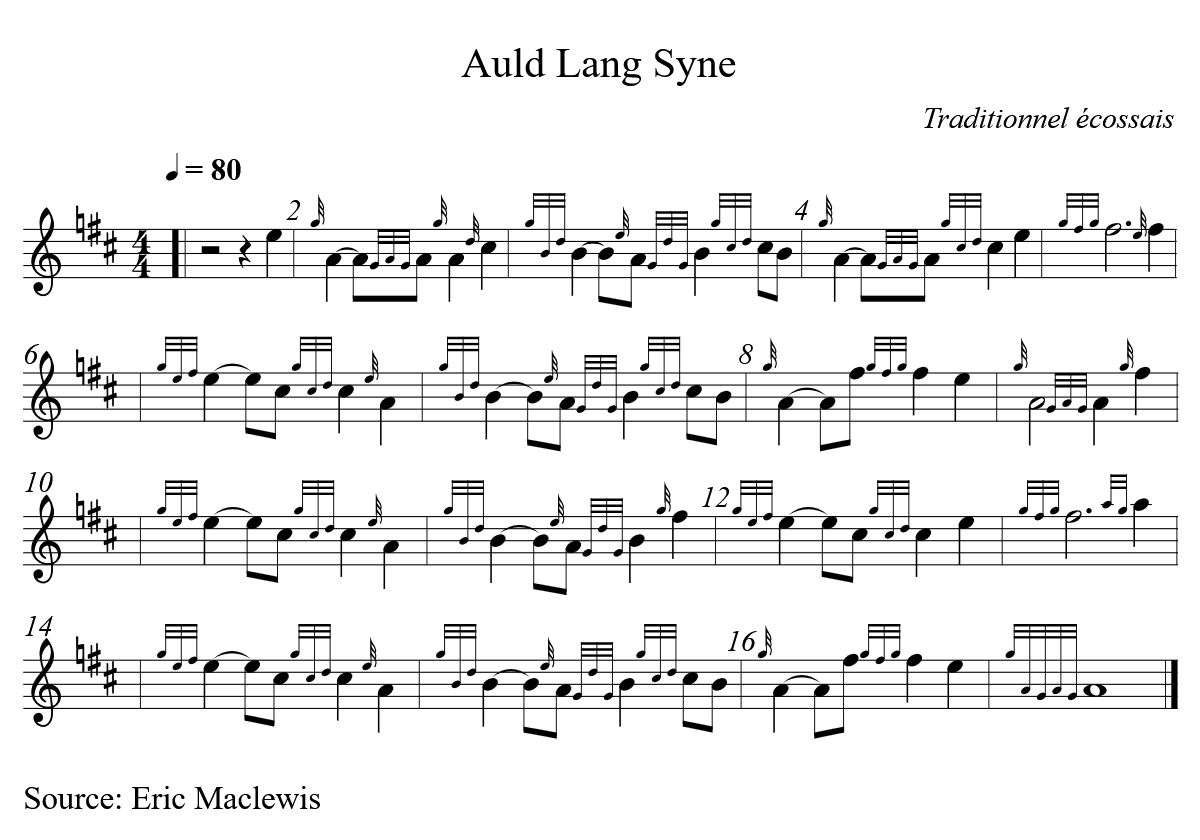
Auld Lang Syne is one of the most famous Scottish songs in the world. The lyrics were collected and published in 1788 by Robert Burns, a major figure in Scottish culture, based on an older traditional folk song. The title can be roughly translated as “for old times’ sake,” “long ago,” or “for old memories.” The lyrics reflect themes of friendship, the passing of time, and loyalty to old bonds.
Today, the general public almost immediately associates Auld Lang Syne with New Year’s Eve celebrations. In the English-speaking world, it is traditionally sung at midnight on December 31st, especially during the Scottish Hogmanay, where participants form a circle while holding hands. During the 20th century, its widespread popularity in North America was reinforced by the New Year broadcasts of bandleader Guy Lombardo. The song is also commonly performed at graduations, farewells, memorials, and any occasion symbolizing an ending and a new beginning.
In Scottish pipe bands and traditional ensembles, Auld Lang Syne is very often played on the Great Highland Bagpipe, either as a solemn air or as the finale of a concert or parade. Its simple and instantly recognizable melody is perfectly suited to the collective sound of bagpipes and drums. It is also frequently heard during both civilian and military gatherings, where it takes on a majestic and emotional dimension.
In Brittany, Bagad groups naturally adopted it into their repertoire, particularly in interceltic and festive contexts. Performed with bombardes, bagpipes, and Scottish snare drums, the piece becomes a musical bridge between Brittany and Scotland. It is often chosen as the finale for performances, tributes, and large gatherings because of its universal emotional power.