
The Rock and the Wee Pickle Tow
1 score
-
The Rock and the Wee Pickle TowBagpipe
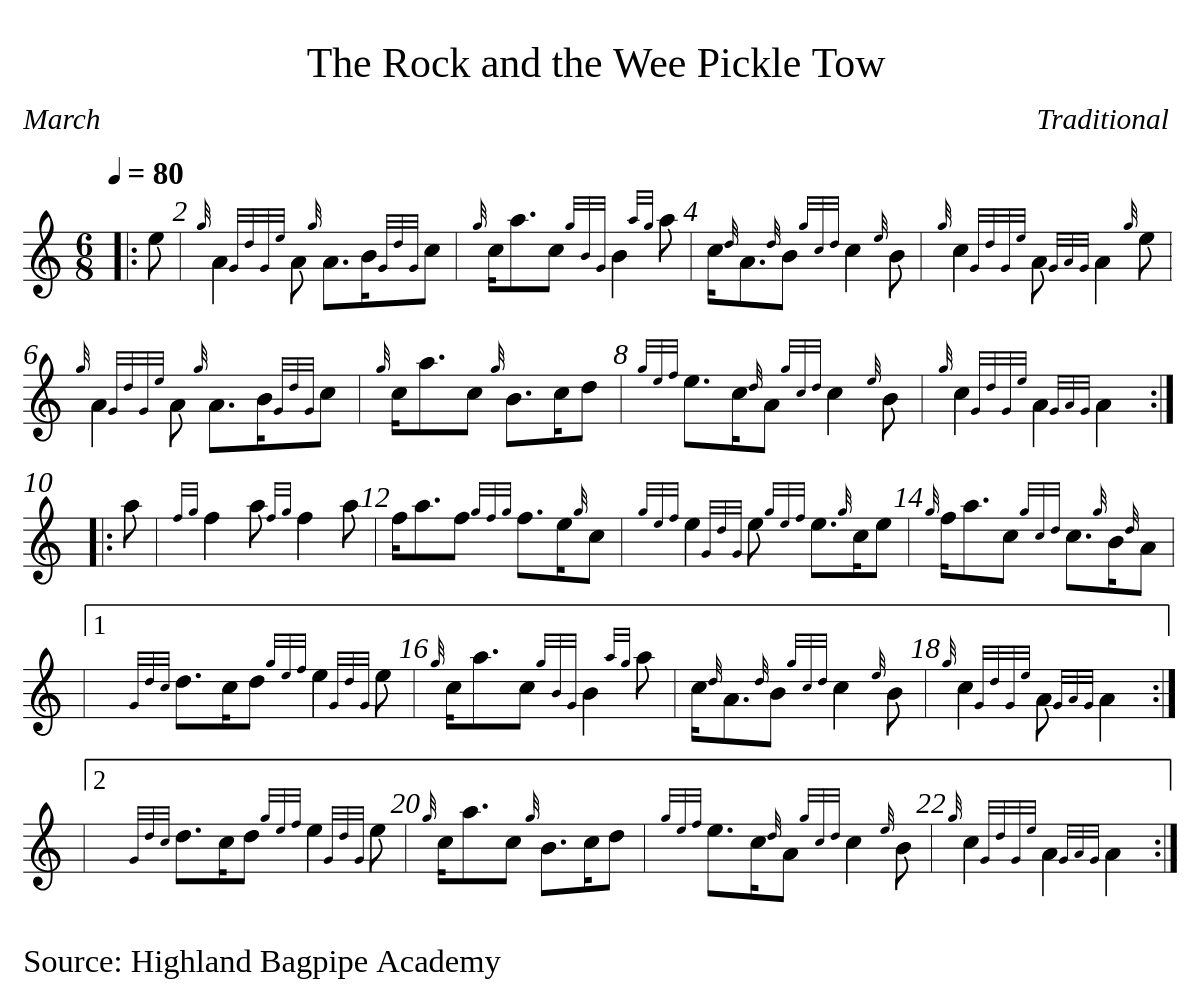
The Rock and the Wee Pickle Tow is one of the oldest melodies in the Scottish repertoire. It was first published by John Playford in 1663 under the title A Scottish March, then in 1669 as Montrose's March. Recent research has shown, however, that the melody existed in Ireland as early as 1652, casting doubt on assumptions about its purely Scottish origins.
The current title is linked to a song written by Scottish poet Alexander Ross (1699–1784), published in The Scots Musical Museum — the great collection of Scottish songs to which Robert Burns contributed. The song describes a woman struggling with her spindle and distaff (rock), her mishaps with spinning, and her rising anger.
In Ireland, the melody is known as O'Sullivan's March, associated with the epic winter march of Donal Cam O'Sullivan Beare from Dunboy Castle in Cork to Leitrim in 1601 — a tragic retreat from which, of a thousand who set out, only seven survived. In Scotland, it serves as the official march of the town of Linlithgow under the title Lord Lithgow's March. Few melodies can boast such longevity and such a diversity of identities across the British Isles.
Performances of The Rock and the Wee Pickle Tow
Lyrics
There was an auld wife had a wee pickle tow,
And she wad gae try the spinnin' o't;
She louted her doun, and her rock took a-low,
And that was a bad beginnin' o't.
She sat and she grat, and she flat and she flang,
And she threw and she blew, and she Wriggled and wrang,
And she chokit and boakit, and cried like to mang,
Alas, for the dreary beginnin' o't!
I've wanted a sark for these aught years and ten,
And this was to be the beginnin' o't;
But I vow I shall want it for as lang again,
Or ever I try the spinnin' o't.
For never since ever they ca'd as they ca' me,
Did sic a mishap and mishanter befa' me;
But ye shall ha'e leave baith to hang and to draw me,
The neist time I try the spinnin' o't.
I ha'e keepit my house now these threescore o' years,
And aye I kept frae the spinnin' o't;
But how I was sarkit, foul fa' them that speirs,
For it minds me upo' the beginnin' o't.
But our women are now-a-days a' grown sae braw,
That ilk ane maun hae a sark, and some ha'e twa-
The warlds were better where ne'er ane ava
Had a rag, but ane at the beginnin' o't.
In the days they ca' yore, gin auld fouks had but won
To a surcoat, hough-syde, for the winnin o't,
Of coat-raips weel cut by the cast o' their bum,
They never socht mair o' the spinnin' o't.
A pair o' grey hoggers weil cluikit benew,
Of nae other lit but the hue of the ewe,
With a pair o' rough mullions to scuff through the dew,
Was the fee they socht at the beginnin' o't.
But we maun ha'e linen, and that maun ha'e we,
And how get we that but by spinnin' o't?
How can we ha'e face for to seek a great fee,
Except we can help at the winnin' o't?
And we maun ha'e pearlins, and mabbies, and cocks,
And some other things that the ladies ca' smocks;
And how get we that, gin we tak na our rocks,
And pow what we can at the spinnin' o't?
'Tis needless for us to mak' our remarks,
Frae our mither's miscookin' the spinnin' o't,
She never kenn'd ocht o' the gueed o' the sarks,
Frae this aback to the beginnin' o't.
Twa-three ell o' plaiden was a' that was socht
By our auld-warld bodies, and that bude be bought;
For in ilka town siccan things wasna wrocht-
Sae little they kenn'd o' the spinnin' o't!